Ultralow-Friction in Graphene–Nanodiamond Functionalized DLC Coatings: Transfer-Layer Evolution Under Variable Load and Humidity
Abstract
Diamond-like carbon (DLC) coatings are widely used as protective and self-lubricating surfaces in metal–metal contacts. Their frictional behavior is governed by the formation and evolution of carbon-rich transfer layers (TLs), which can be tailored through functionalization with carbon nanomaterials. Recent studies have shown that graphene sheets (GSs) and nanodiamonds (NDs) act synergistically to achieve ultra-low friction in microrough (~0.2 μm) metal–DLC contacts under dry N2 at a 1 N load. Here, we probe how this lubrication mechanism evolves with increasing load from 1 to 10 N—corresponding to local contact pressures up to ~11–16 GPa—respectively, in dry N2 and humid air conditions. Ball-on-disk experiments are performed on an industrial hydrogenated DLC coating sliding against stainless-steel. In dry N2, GS–ND functionalization yields a low and stable coefficient of friction across the entire load range, reaching a minimum of about 0.05. In humid air, higher friction levels are observed across all loads (CoF ~0.10–0.15), accompanied by oxidation-driven modifications of both wear debris and the counterface contact region, with oxygen content increasing by more than a factor of three compared to dry N2. Detailed microscopy and spectroscopy analyses indicate that enhanced lubricity in dry N2 arises from TLs incorporating GSs, NDs, and nanoscroll-like structures, whereas humid air promotes interfacial amorphization and oxidation, leading to load-insensitive friction and boundary lubrication effects through physisorbed water molecules.
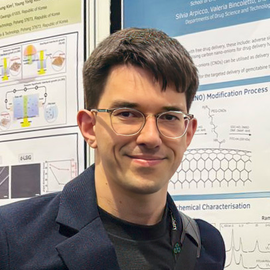
Michał Bartkowski
Postdoctoral Researcher
Michał Bartkowski is currently a Postdoctoral Researcher in the group of Prof. Silvia Giordani at Dublin City University, supported by her Research Ireland Frontiers for the Future Programme grant (2/FFP-A/11067).

Silvia Giordani
Full Professor Chair of Nanomaterials
My research interests are in the design, synthesis, and characterization of hybrid smart nanomaterials for biomedical, energy and environmental applications